
18 May 2026 · 9 min read · Afrofuturism / Design / Worldbuilding
What Afrofuturism actually means for animators and designers: a practical guide to building future worlds from African heritage, from the studio behind The Lost Comb of Mawu.
By Kwame-Michael Brako, Founder of BrakoVerse Media
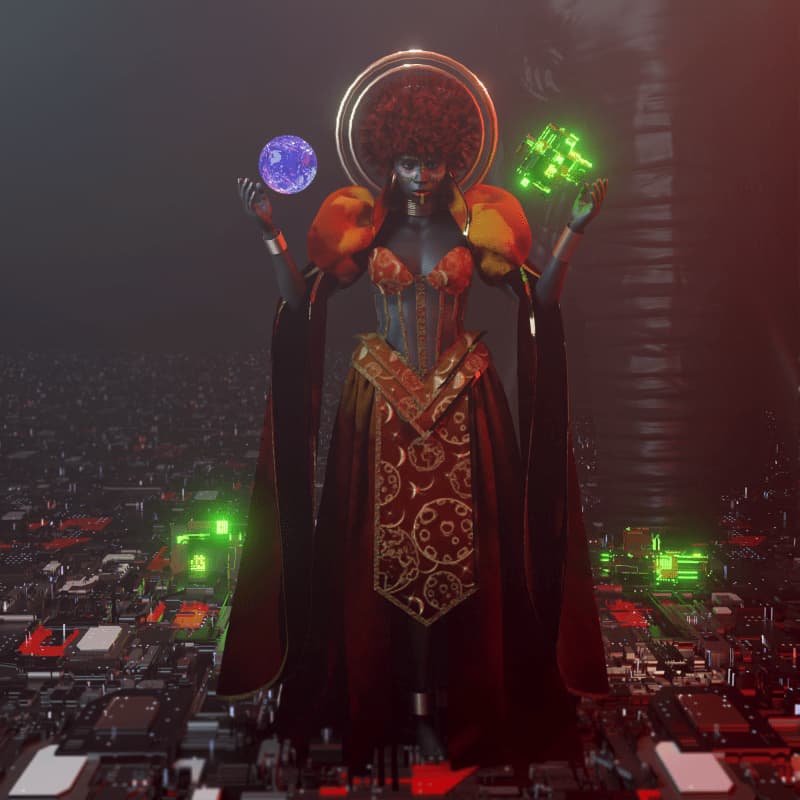
Afrofuturism gets used as a buzzword so often that its working definition has gone soft. For a studio that builds Afrofuturist worlds professionally, the term has to mean something concrete enough to design with. This guide shares how we approach it at BrakoVerse: as craft, not costume.
Start with the cosmology, not the chrome
The most common Afrofuturist mistake is starting with science fiction and decorating it African: kente on a spacesuit, adinkra on a hull. The result photographs well and means nothing. Authentic worldbuilding inverts the order. Start with the cosmology and let it generate the technology.
Our flagship IP, The Lost Comb of Mawu, begins with the creation goddess of Ewe and Fon tradition. The question that built the universe was not 'what does an African spaceship look like?' but 'what kind of technology would a civilisation build if it had never stopped believing memory is sacred?' From that single premise flow design rules for everything: architecture, vehicles, interfaces, even how light behaves. The chrome takes care of itself when the cosmology is load-bearing.
Research is a design department
Every culture referenced in a frame is someone's inheritance, which makes research a production discipline rather than a preliminary step. In practice: we treat textile patterns, oral histories, royal regalia and spiritual symbols as primary sources, documented and credited in our design bibles like any other reference.
This has a craft payoff beyond ethics. Real traditions are stranger and richer than invented ones. The geometry of authentic kente carries mathematical structure no random pattern generator produces. The history of the Asante Golden Stool contains more narrative voltage than most fantasy novels. Accuracy is not a constraint on imagination. It is fuel for it.
Design the future as a continuation, not a rupture
Western science fiction often imagines the future as a break with the past: old world demolished, glass towers on the rubble. Afrofuturism's deepest move is imagining the future as a continuation, with ancestors present, traditions evolved rather than erased, and technology grown from heritage like a tree from roots.
Visually, this principle changes everything. Surfaces carry age and ornament. Cities grow around sacred sites rather than over them. Interfaces use symbol systems that elders could read. In our Mawu 3001 concept work, orbital structures pattern themselves on adinkra geometry: a deep future that has never stopped being African. When audiences say a world 'feels real,' continuity is usually what they are sensing.
A practical checklist for animators
If you are building Afrofuturist work, interrogate your frames with five questions. One: can you name the specific tradition behind each cultural element, or is it generically 'African'? Two: does your technology have a cultural logic, or is it Western sci-fi repainted? Three: do your characters' bodies, hair and skin get the same shading care as any Hollywood lead? Four: is the past present in your future, through ancestors, ritual, memory? Five: would someone from the culture you are referencing recognise themselves, or just their wardrobe?
Afrofuturism, done with craft, is not a genre aesthetic. It is a worldbuilding engine powerful enough to run studios, franchises and careers. The continent's archives are deep, the audience is global and the tools have never been more accessible. Build with respect, and the future is enormous.
About BrakoVerse Media
An African-led creative studio building cinematic stories, immersive worlds, and future-facing media rooted in culture. Founded by Kwame-Michael Brako, with 15+ years of Hollywood VFX on The Avengers, Iron Man, Godzilla, Guardians of the Galaxy.
Start a project with us →Keep reading